Web Officers
burt.laura.a1@dol.gov
albrecht.brian@dol.gov
hill.jedd.r@dol.gov
jillings.leeanne@dol.gov

Tickborne Disease - Background

Tickborne Disease - Background

h6 {text-transform:unset;}

Background

Ticks are responsible for more than a dozen known tickborne diseases, including Lyme disease, Rocky Mountain Spotted Fever (RMSF), and Anaplasmosis. Transmission varies geographically based on where the ticks and reservoirs (e.g., deer, mice, etc.) live. Although Lyme disease is the most reported tickborne illness, other illnesses are increasingly being identified.
Tickborne Disease - Overview

Tickborne Disease - Overview

hr{ clear:both; } .wrapped{word-wrap:break-word;} .safety-health-body-content{ padding-right:0; } @media only screen and (max-width: 979px) { .nopad{padding:0;} }

Overview

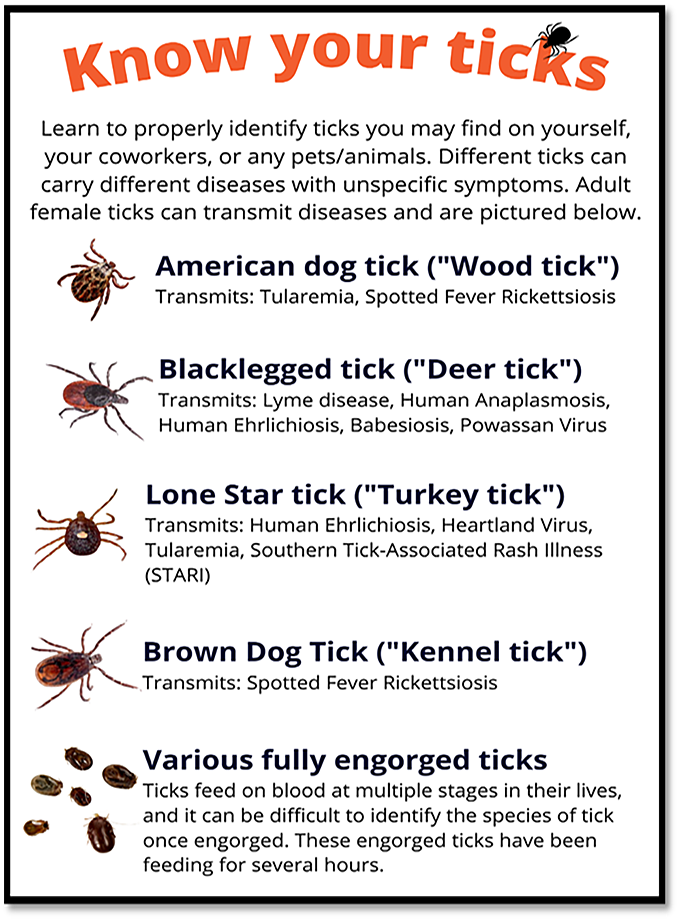
Know Your Ticks

Clarification on the work-related exception in 1904.5(b)(2)(viii) for the common cold or flu

OSHA requirements are set by statute, standards and regulations. Our interpretation letters explain these requirements and how they apply to particular circumstances, but they cannot create additional employer obligations. This letter constitutes OSHA's interpretation of the requirements discussed. Note that our enforcement guidance may be affected by changes to OSHA rules. Also, from time to time we update our guidance in response to new information. To keep apprised of such developments, you can consult OSHA's website at https://www.osha.gov.

November 15, 2023

Ms. Riki Ott, PhD
Director, The ALERT Project
Berkeley, CA 94704

Dear Ms. Ott:

Thank you for your letter to the Occupational Safety and Health Administration (OSHA) regarding the recordkeeping regulation contained in 29 CFR Part 1904 Recording and Reporting Occupational Injuries and Illnesses. Specifically, you request an interpretation regarding the work-related exception in § 1904.5(b)(2)(viii) for the common cold or flu.

OSHA Technical Manual (OTM) – Section II: Chapter 1, Personal Sampling for Air Contaminants - UPDATED

  • Record Type:
  • Current Directive Number:
  • Title:
  • Information Date:

This chapter (Section II (Health Hazards), Chapter 1), provides technical information for Compliance Safety and Health Officers (CSHOs) for sampling air contaminants. The content is based on current industry practices, research publications, OSHA standards, and consensus standards. The chapter is divided into five main sections and includes nine appendices. For the full language of the notice, see TED 01-00-015 - OSHA Technical Manual.


Determining if injuries or illnesses are work-related as a result of an act of violence

OSHA requirements are set by statute, standards and regulations. Our interpretation letters explain these requirements and how they apply to particular circumstances, but they cannot create additional employer obligations. This letter constitutes OSHA's interpretation of the requirements discussed. Note that our enforcement guidance may be affected by changes to OSHA rules. Also, from time to time we update our guidance in response to new information. To keep apprised of such developments, you can consult OSHA's website at https://www.osha.gov.

May 17, 2023

Mr. Travis W. Vance
Fisher & Phillips LLP
227 West Trade Street
STE 2020
Charlotte, N.C. 28202

Dear Mr. Vance:

Thank you for your letter to the Occupational Safety and Health Administration (OSHA) regarding the recordkeeping regulation contained in 29 CFR Part 1904 – Recording and Reporting Occupational Injuries and Illnesses. Specifically, you request clarification on whether an employee's injury would be considered work-related as a result of an act of violence.